If you just had a gorgeous new polyaspartic coating installed on your garage floor, the anticipation is real. It looks sleek, it looks tough, and you probably want your garage back.
But before you start wheeling the toolbox back in or parking the SUV, there is a massive piece of misinformation out there we need to clear up.
If you ask Google, “Can I use my garage floor 24 hours after a polyaspartic coating?” you will see a lot of generic articles telling you it’s completely fine.
As a professional installer, I am here to tell you: Not so fast.
While polyaspartic cures incredibly quickly compared to old-school epoxy, there is a strict difference between walking on your floor and driving on it. Let’s break down the real-world timeline, what happens if you cheat the clock, and the rules we use to guarantee a flawless finish.
The Real Timeline: People vs. Pistons
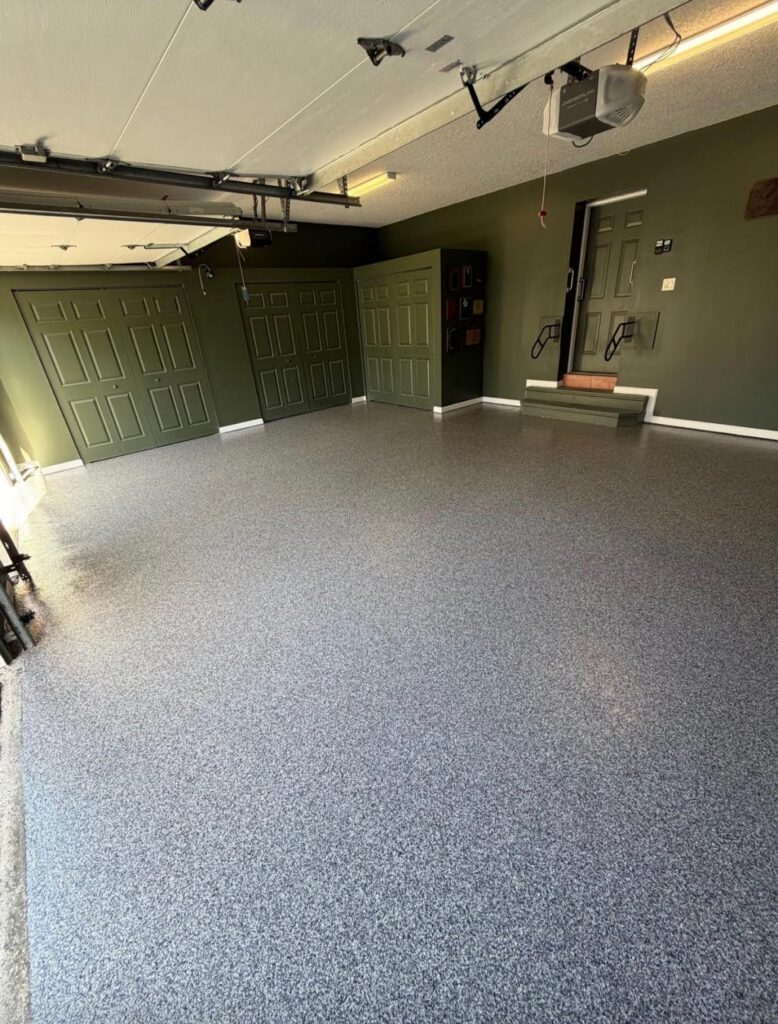
Polyaspartic is famous for its fast cure time, but it still requires a two-stage timeline to fully cross-link and harden. Here is our golden rule for a standard full-flake or solid-color flake system:
- At 24 Hours: Foot Traffic & Light Items. You can safely walk on the floor, move your lighter belongings back in, and organize your space.
- At 48 Hours: Vehicles & Heavy Items. Do not drive a car, park a heavy EV, or slide massive storage cabinets onto the floor until a full 48 hours have passed.
The 48-Hour Tire Rule: It doesn’t matter if you drive a compact sedan, a heavy electric vehicle (EV), or a sports car with hot performance tires. Every single vehicle needs to wait the full 48 hours. Cheating this timeline risks ruining the coat.
The Reality Check: What Happens if You Drive on It Too Early?
Many homeowners think, “Well, it feels hard to the touch, so what’s the worst that could happen if I just pull the car in?”
Let me give you a real story from the field. We had a client who ignored the 48-hour vehicle rule and drove onto the floor early because it “looked ready.” Because the polyaspartic hadn’t fully chemically cured beneath the surface, the heavy weight and heat of the tires left permanent, deep marks locked right into the coating.
The fix isn’t as simple as painting over it. Our team had to bring out the industrial grinders, physically grind away the ruined topcoat, prep the area all over again, and reapply a brand-new topcoat.
It turns a fast project into a massive headache. Trust the timeline — it’s worth the wait.
Chemistry Matters: Behind the Scenes of a Pro Install
A lot of variables go into making sure your floor cures perfectly within that 24-to-48-hour window. Here is how professional installers ensure success:
1. Summer vs. Winter Chemistry
Polyaspartic isn’t a “one-size-fits-all” liquid. We use entirely different product formulations depending on the season. Summer blends are designed to cure correctly in high heat and humidity, while winter blends are chemically adjusted to harden in the freezing cold. Using the wrong blend at the wrong time of year means the floor won’t cure properly.
2. The Moisture Shield
Have you ever seen a polyaspartic floor bubble or peel up months later? That usually happens because of hidden moisture trapped inside the concrete slab. To prevent this, our team always measures the moisture levels in your concrete before a single drop of product touches the floor. If the moisture is too high, we address it first. If an installer isn’t measuring your moisture, they are guessing with your investment.
3. Conquering the Smell
Homeowners always ask about the fumes. Polyaspartic does have a strong scent while it applies and cures. Our recommendation is simple: leave your garage door open halfway for the first 24 hours. This allows proper airflow so the product can cure efficiently. Once those 24 hours are up, you can shut the door completely, and the smell will be entirely gone.
The Final Verdict: The “Thumbprint” Test
If you are approaching the 24-hour mark for foot traffic and want to be absolutely sure your floor is ready for your boots, use the simplest test in the book: Find a discreet corner and press your thumb firmly into the coating.
If it feels even slightly tacky or sticky, it is not ready. Step away and give it more time.
A polyaspartic garage floor is a lifetime investment that adds massive value to your home. Don’t let a missing 24 hours stand between you and a flawless floor!
Thinking about transforming your garage? Reach out to our team today for a free estimate, and let’s build a floor that lasts.